Tuesday, June 13, 2017

Target market - define yours for more visits and sales

Who is your target market?When you build a house, you need a solid foundation. When you form a business of selling, you need to figure out who your typical customer is. Build your business on that foundation of your target market.

Many sellers feel that their target market is "everyone." But no one shop's appeal is that broad. You must delimit your potential audience. If you do not, you can get discouraged very quickly when sales are slow.

Besides, if your target market is "everyone" you need to market to them. No one can afford to market to everyone. No one.

Here is an example: if you are watching a major sporting event, you will see different commercials than shown during a children's cartoon. The same with an afternoon soap. Why? Even big corporations with a large budget target a specific market and not everyone.

With a clearly defined target audience in mind, it is simpler to determine how and where to market your items. In fact, small Etsy shops can easily compete with large shops by targeting a niche market. 

This does not mean that you are excluding people who do not fit your criteria. Rather, target marketing allows you to focus your marketing efforts on a specific slice of market, the people that are more likely to buy from you. 

The goal is to reach other people like them who could also love your products. Tailor your marketing to them. 

Most shops have a small market. How can we get seen by our best potential customers?

Defining your target customer is essential for effective selling. It is the most affordable, efficient, and effective way to reach potential clients and generate business.

To define your target market requires detective work. Ask yourself some questions:


Who is your current customer base? What are their common characteristics and interests? Which factors bring in the most business? Why do they buy from you?

What products do you sell? Make a chart. Include your types of products. Next to each feature, list the benefits each type of item provides (and the benefits of those benefits). For example,

Once you have your benefits listed, make a list of people who have a need that your items fulfill.

What about your competition? Who is their target market? Who are their current customers? It is not necessary to copy them, but you may find a niche market that they are overlooking.

What details do you need to concentrate on?  Figure out not only who has a need for your items, but also who is most likely to buy it. It is time for some market research. Here are some demographics to consider:
target audience for our vintage etsy shop
Who are your peeps?
  • Age - 20's? 40's?
  • Gender - male or female?
  • Occupation
  • Location - USA? Worldwide?
  • Income level
  • Education - high school? college?
  • Family status - single collectors? Married mothers?
  • Ethnic background

varied look of target audience
Target markets come in many shapes
Try getting even deeper, consider things like:

  • Personality
  • Attitudes
  • Values
  • Interests/hobbies
  • Lifestyles
  • Behavior

How do your items fit into your target's lifestyle? What types of things are most appealing to your target? How and when will your target buyer use your items? 

Does your target market use social media? Other websites? Should you expand to another selling website? Should you start your own website?

Do not break down your target too far... You can have more than one niche market.

Signs that you may have broken down your target market too far:
1. You can reach more than one niche effectively with the same message.
2. If there are only 50 people that fit all of your criteria.

Find a balance.


How do I find all this information?


Educate yourself about your target market. Read magazine articles and blogs that talk about your target market. Read material that talks to them. Peruse blogs and forums where people in your target market express their opinions. Look for survey results, or consider conducting a survey of your own. You could ask your current customers for feedback.

Once you have determined your target market, evaluate your decision. Consider these questions:
  • Are there enough people out there who fit my criteria?
  • Will my target market really benefit from my items? Will they see a need for them?
  • Can they afford my products?
  • What drives my target market to make decisions?
  • How do I reach them with my message? Are they accessible?

Whew, that is a lot of work! Here is a fun way to do itDefining your target market is the hard part.

Once you know who you are targeting, it is much easier to figure out how to reach them and what message will resonate with them. Visits and sales will follow.

So, who is your target market? How can you reach them with your message?

 Here is more reading. Here is a recent forums discussion on the subject.

Still stuck? Here is a great case study on finding your target market. (More information on the subject from Etsy.)

Friday, June 9, 2017

Etsy Quick Trick: Forums & Team Search

better etsy forums search method

Regularly seen in Etsy's forums is this query:
"Whenever I have a question, I like to search to see whether it has been asked before. But all I find are irrelevant threads. What am I doing wrong?"

better search results from Etsy forums
Searching the forums can be a challenge!

There are two tricks to finding the information you need from the forums, or even team threads:

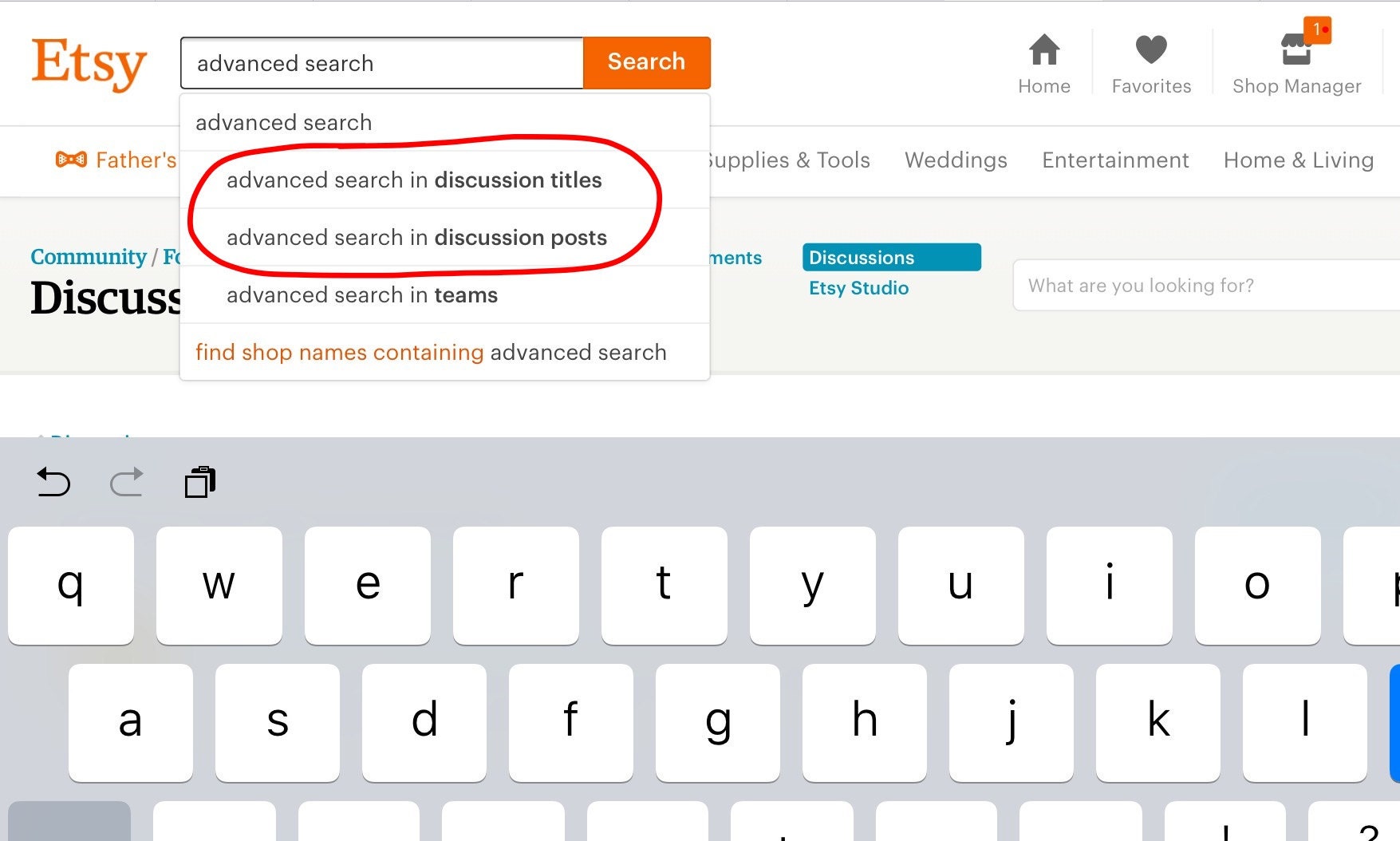
  1. First, go to the forum most likely to answer your query, like Questions, Discussions, or your team
  2. Next, go to the topmost search field on the page. Begin to type your query.
  3. As you type your query, some choices will pop up.
  4. Quick search Etsy's forums
    Select your choice, titles or inside posts
  5. Select one and voila! your answers.

Use a Google Search


Another method is to make a search from Google. Something like "Etsy xxxx."

Be aware that in a Google search, the results need to be indexed first. So your results may be older than the first method described.

If you use the Google search method for a teams search, the thread must be public.

I hope that this journey into searching Etsy's communities has been helpful!


Friday, May 19, 2017

Etsy's new stats - why VISITS matter


Many wonder why Etsy switched from "views" to unique visitors ("visits"). The truth is, there is more information to be gleaned from unique visitors than plain old views.

In fact, your sales-to-visits-ratio can accurately predict how many sales you can make. Did I just say that you can predict how many sales you will have? I did! 

Use this simple equation to calculate your conversion rate:


Sales (or conversions) / visits x 100 = your conversion rate (a percentage). 

Click this link to see the raw numbers for your shop's data for this year. The two numbers you need are the number of orders and the number of visits. Plug them in and voila, you have your number.

Your answer is how many per 100 unique visitors to your shop actually buy from you.  Pure and simple, the more unique visitors, the more sales you make.
conversion rate calculation graphic
How has your conversion rate changed over time?

Industry standard is said to be 3%. I was unable to find a vintage shop on Etsy that is anywhere near that number. The sellers I polled averaged from 0.7 to 1.5 for their conversion rate.

It is difficult to compare between shops because there are so many variables. Do not be so concerned about what your individual number is.

The best thing to do is to know what your conversion rate is and keep track of it. New shops should begin tracking this number at about three months of sales.

Once you start, there is no need to do it every day, or even every week. Record your conversion rate about once a month, for that month. Look for trends in the number as time passes. 

If you have never tracked this number, you can go back into your statistics. Pull these numbers from your past data and look for trends.


As your visits go up, watch the sales pile up. If your ratio goes down, try to determine why 🔍.

Wednesday, May 17, 2017

What happens if Etsy gets sold?

Will the sale of Etsy change anything?
Is Etsy for sale? Is that a bad thing?
Would would it mean if Etsy were sold? Rumors abound about it.

It is really a matter of ownership: do the current stockholders continue to own Etsy, or will someone else step in? If they did, would it make a big difference?

I went into a panic about this a couple of weeks ago... Will life here as we know it end?

Someone pointed something out to me:

(Taken from Wikipedia)

"Founded by Steve Ells in July 1993, Chipotle had 16 restaurants (all in Colorado) when McDonald's Corporation became a major investor in 1998. By the time McDonald's fully divested itself from Chipotle in 2006, the chain had grown to over 500 locations."

Think about it: when McDonalds had a large stake in Chipotle Grill, did they go and change all of the restaurants to McDonalds? No, instead Chipotle expanded greatly. 

Being taken over could mean getting improvements and upgrades like phone support and better site releases. Not so many site bugs would be nice, would it not?

So being sold might not be a bad thing. Regardless of how it plays out, Etsy is changing. 

Hopefully we all like what Etsy becomes, is becoming.

Handling negative feedback like a pro

Etsy seller reaction to negative feedback
Negative feedback happens to us all
If you sell long enough, it happens to you. We all receive negative feedback. It is just a fact of online selling.

Yikes, negative feedback!

First off, take a deep breath. Step back. Relax for a day.

Most have heard the saying, “life is 10% of what happens and 90% of how you react to it.”

Negative feedback is one of those situations where you have limited control over what happens, but you CAN control your reaction. Your public reaction to bad feedback is one barometer that potential buyers use to decide whether or not to make a purchase with your shop.

Should you leave a response to negative feedback?


What will you say? After someone buys from you and has an issue, how will they be treated? You would not want to shut the door on future purchases from your shop by blaming past buyers, would you?

Experienced sellers have always counseled me to avoid commenting on the few negs my shop has received. That is what I have done, not to comment at all and move on.

Etsy does allow sellers to respond to negative feedback, if it is three stars or less. Sellers have 60 days from the last feedback revision by the buyer.

There is a caveat: once you respond, the buyer feedback cannot be changed. Interestingly, you can remove your response should you change your mind. But the buyer's feedback remains locked in place.

Remember, "you catch more flies with honey than you do with vinegar."

How can I prevent this next time?


Do some soul searching. Is there any truth to what was said? Can you improve in your item descriptions, photos, packing or customer service?

Use it as a learning experience. As a buyer, how would you want to be treated?

Why do people do it?


Feedback is, after all, the buyer's opinion. "You can please some of the people some of the time, but you cannot please all of the people all of the time."

Savvy shoppers realize this. They will overlook a minor amount of negative feedback buried in a mass of stellar reviews.

Buyers come in various moods. A few buyers may choose to spread their bad mood by leaving negative feedback. In that case, you can wait a day or two and perhaps reach out to the buyer to see if anything can be done.

No seller wants negative feedback
Stars are important!

Will Etsy remove negative feedback?


Etsy rarely removes feedback. Of course, they may remove feedback that violates their policies. That would be things like exposing private information or harassment. They may also remove it if the review is for a third party (for example, the buyer berates the postal service, or hates Etsy's automated service asking them to review you).

I can remember when eBay started. The new world of online auctions required some checks and balances. The feedback system was a revolutionary way to assess sellers.

Now, decades later, feedback remains relatively unchanged. Most buyers are kind and forbearing when they do leave feedback.

Buyers still do still leave negative feedback, unfortunately. We must improve if there is room for it... endure if it is unwarranted.

And keep selling.
 😁

Saturday, May 13, 2017

Etsy Sells Vintage - social media initiative

Etsy Sells Vintage Social Media Image
Social Media Image - Etsy Sells Vintage
You are already aware that Etsy sells vintage items. However, many potential buyers are not.

There is a movement afoot to advertise that vintage is thriving on Etsy (as well as handmade and crafting/DIY).

The hashtag is #etsysellsvintage. Feel free to use the image here.

Post it on whatever social media you use: Instagram, Pinterest, Facebook, Google+. Even on the Etsy Forum threads. Share this on your Etsy teams. Blogs, too.

Some have even changed their social media avatars.

It would be so nice for Etsy to advertise that vintage thrives along with handmade and crafts... but if they do not, at least WE can. 

Give Etsy vintage a bump. Please join other vintage sellers in this social media campaign to get the word out!

Monday, May 1, 2017

Does Hearting Matter? (10/2016 Admin Update)

To heart or not to heart, that is the question. Here on Etsy, we have been ❤️ for years. Should we continue to heart?

Have you been here long enough to remember when Etsy rolled out Studio (now discontinued)? Some feel that this was the direction of Etsy as a whole: less shop branding, no favorites. Hmmmm.
Should sellers favorite items?
Etsy favorites debate

Here is a question posed to Etsy Admin on favoriting:

Q: I heard that relevancy on the search is based on the amounts of views/favorites/sales an item gets after is searched. Am I right?

Now, I understand that because teams where playing some favorite games, the direct "favoriting" items won't affect his rank. My question is: I share a lot of my listings in social media, and I know for my views that many people are clicking on those links and favoriting some of them. Will this improve in what page my items are shown on the search, or it only gets affected by favoriting through Etsy search engine?

Can we get some extra tips on how to make it work better for us (ones that aren't on the seller handbook)...

Admin:
Yes you are correct, any external likes or shares outside of Etsy will not affect your visibility on Etsy.com. On the other hand, Google has said that while there isn’t a direct correlation between social and SEO rankings, studies have shown there is correlation between SEO rankings and social signals. 

You are also correct in saying favoriting listings or click farming won’t have an effect on your rankings. On the contrary I would think of it as, the more buyers engage with your listing, the more positive signals your listing will send that factor into your visibility on Etsy search.

As for extra tips, we would recommend adding as much relevant content on your listing and shop page as possible. Attributes such as color, size, material and gender would be examples of more descriptive content.
--------------------------------------
So Etsy here is saying that hearting has no effect on how our items place in search. (Or clicking, for that matter. Social media likely helps.)

Is this really true? Many sellers say no. What do you think? Does hearting work for you?

Selling vintage in uncertain times

With coronavirus, we have seen supply chain disruptions, stock market fluctuations, even companies temporarily stopping business. The news s...